

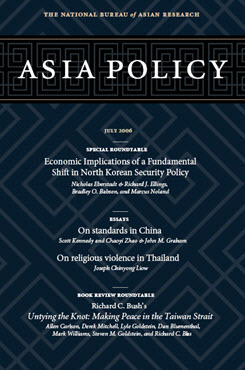
International Jihad and Muslim Radicalism in Thailand?
Toward an Alternative Interpretation
This research note explores the extent to which radical Islamic ideology—particularly as linked to a wider international movement—is responsible for recent violence in southern Thailand.
EXECUTIVE SUMMARY
MAIN ARGUMENT
Though the conflict in southern Thailand is becoming increasingly colored by religion, there is scant evidence to suggest links either to any radical Islamic ideology that exhibits links to pan-Islamism or to broader global jihadi terrorism and violence. The conflict in southern Thailand remains rooted not only in the political ideology of Malay-Muslim nationalism and separatism but also in the state’s misguided policies to deal with the violence.
POLICY IMPLICATIONS
- U.S. policymakers must be careful not to conflate the ongoing violence in southern Thailand with global terrorism as there is currently no convincing evidence that the separatist struggle has been subsumed into a larger global jihad.
- Because the nature of violence in southern Thailand is primarily rooted in local grievances rather than radical Islamist ideology, Washington and Bangkok would benefit from taking concrete steps to identify and address these local grievances.
- In order to avoid further radicalizing Malay-Muslims—and thereby render them more susceptible to the appeal of violence and militancy—Bangkok must mitigate both tactical and public relations disasters (such as those at Krisek and Tak Bai) and state-sanctioned acts of injustice.
About Asia Policy
Asia Policy is a peer-reviewed scholarly journal presenting policy-relevant academic research on the Asia-Pacific that draws clear and concise conclusions useful to today’s policymakers. Asia Policy is published quarterly in January, April, July, and October and accepts submissions on a rolling basis. Learn more