

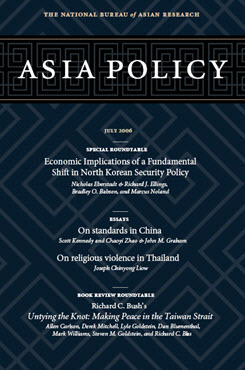
The Political Economy of Standards Coalitions
Explaining China's Involvement in High-Tech Standards Wars
This essay seeks to explain China’s inability to successfully adopt and commercialize new technology standards by contrasting two standards development cases: wireless local area networks and home networking.
EXECUTIVE SUMMARY
MAIN ARGUMENT
Technology standards are often the result of conflict between competing industry coalitions, which derive their strength from both political and economic sources. Several of the coalitions supporting unique Chinese standards, most notably for wireless local area networks (LAN), have been narrow and weak relative to the coalitions formed by their foreign competitors. Other less publicized efforts, such as those in home networking, have attracted a broader base of support and as a result show genuine commercial promise.
POLICY IMPLICATIONS
- As long as the industry coalitions supporting Chinese efforts to set unique technical standards in information technology are narrow, the opposition both of important segments of Chinese industry and of foreign companies and their governments will cause such efforts to fail.
- Despite high visibility, China’s bid to promote WAPI over Wi-Fi as the international wireless local area network standard is not representative of all Chinese standards efforts. Much of Chinese industry and government increasingly recognize the need to be more transparent and receptive to foreign input during the standards process. In addition, Chinese firms want to contribute constructively to international initiatives as well.
- In order to foster Chinese integration into the global standards community, Western industries and governments should avoid highly politicized conflicts over standards and instead promote transnational business partnerships as well as technical and legal training. This approach would avoid unnecessary trans-Pacific tensions and increase business opportunities for Western businesses.
About Asia Policy
Asia Policy is a peer-reviewed scholarly journal presenting policy-relevant academic research on the Asia-Pacific that draws clear and concise conclusions useful to today’s policymakers. Asia Policy is published quarterly in January, April, July, and October and accepts submissions on a rolling basis. Learn more